
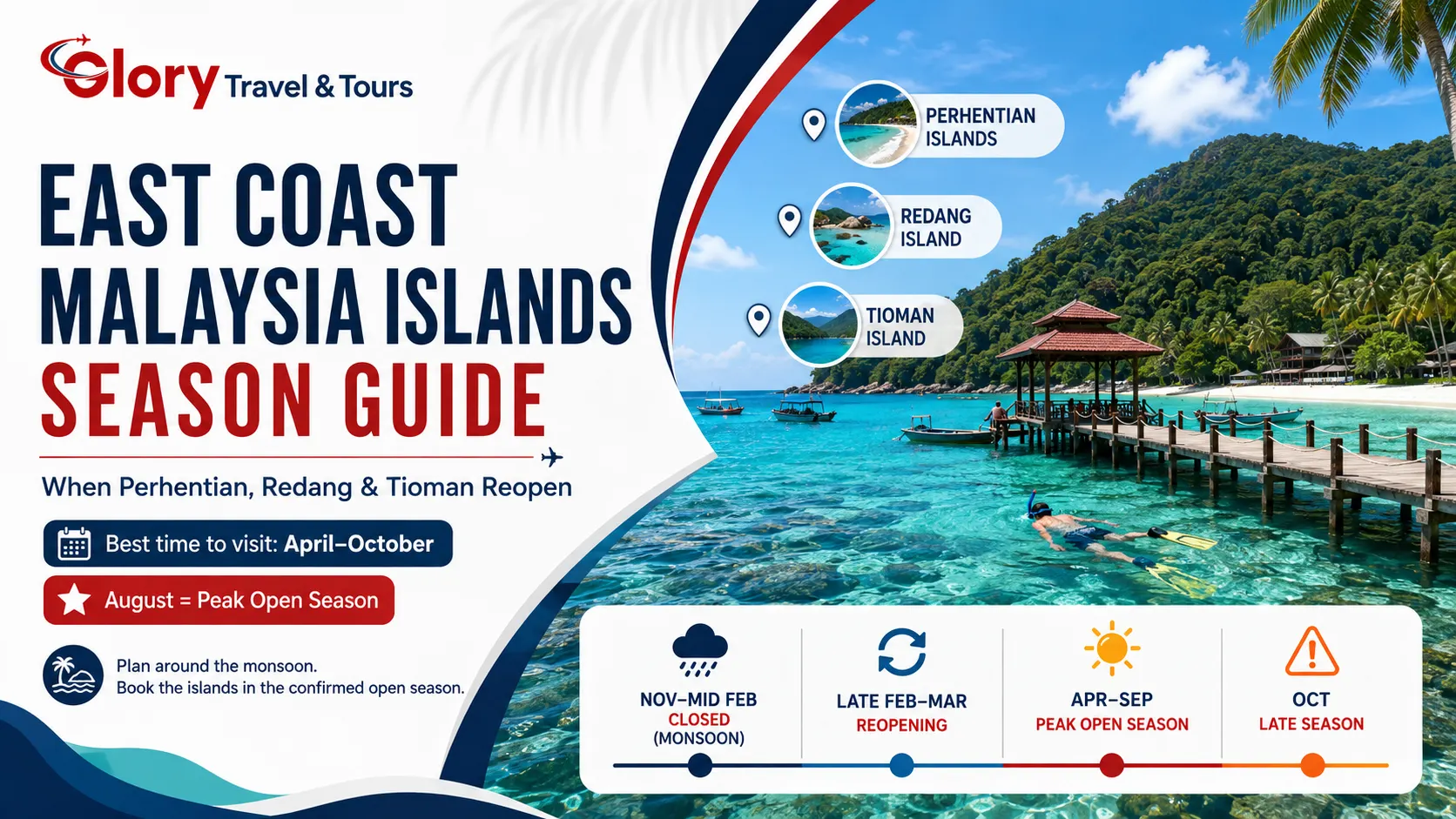
Quick Answer: Malaysia's East Coast islands, Perhentian, Redang, and Tioman, close for the Northeast Monsoon roughly from November through February, with most resorts and ferries fully suspended during that window. They reopen in phases from around March, reach full operation by April, and stay open through October. August sits in the middle of the open season, making it one of the most reliable months to visit any of the three.
Every year, the same booking mistake shows up in East Coast Malaysia travel planning: someone books a Perhentian Island trip for December or January, only to find the resort closed and the ferry not running. It is not a niche risk, it is the default outcome outside the open season. This guide sets out exactly when each island closes and reopens, so an August trip (or any trip) can be planned around real seasonal data rather than guesswork.
Perhentian, Redang, and Tioman all sit on the eastern side of Peninsular Malaysia, directly exposed to the Northeast Monsoon, which brings heavy rainfall, strong winds, and rough seas to this coast roughly from November through February. Unlike the West Coast, where monsoon rain is heavier but rarely disruptive, the East Coast's exposure to open sea means ferry crossings become genuinely unsafe during peak monsoon weeks, and many resorts close entirely for maintenance rather than operate at reduced capacity.
Perhentian Islands Most resorts close by early November and remain shut until late February or early March, when the islands reopen fully. The dry season, and the best time to visit, runs from around late March through early October, with April through August widely considered the peak window for calm seas, marine life, and diving visibility.
Redang Island Redang follows a very similar pattern to Perhentian, with resorts and the small Redang Airport largely suspending operations through the Northeast Monsoon. Redang Airport's Twin Otter aircraft cannot safely operate in the crosswinds that regularly exceed 15 knots during peak monsoon weeks, which is why flight access, not just ferry access, effectively pauses over this period.
Tioman Island Tioman tends to maintain slightly more consistent access than Perhentian or Redang during the shoulder months, with some limited operations continuing into December and resuming a little earlier, around mid-February, than the other two islands. Even so, ferry schedules from Mersing are significantly reduced once swells regularly exceed roughly two metres, and a full-monsoon booking carries the same risk as Perhentian or Redang.
Beyond individual resort decisions, Malaysia's marine parks (which include the waters around Perhentian, Redang, and several other East Coast islands) are subject to an annual gazetted closure during the monsoon season, part of the marine park system's conservation and safety management. This is a separate, additional reason bookings simply are not available during the closed months, on top of resorts choosing to shut for their own operational reasons.
August sits comfortably in the middle of the open season for all three islands, well clear of the shoulder-month uncertainty of March or October. Seas are calm, visibility is good, and by this point resorts are fully staffed and operating at normal capacity after the year's ramp-up. August also coincides with Singapore's National Day and Malaysia's Merdeka Day long weekends, making it a natural window for a short island trip; see our National Day and Merdeka Day Long Weekend guide for specific date-matched itinerary ideas.
|
Period |
Status |
Booking Advice |
|
November to mid-February |
Closed (monsoon) |
Avoid booking; most resorts and ferries are suspended |
|
Late February to March |
Reopening |
Book cautiously; confirm operating status directly before travel |
|
April to September |
Peak open season |
Best window for diving, snorkelling, and reliable ferry access |
|
October |
Late season |
Still generally open, but monitor forecasts as the monsoon approaches |
Never book November through February for Perhentian, Redang, or Tioman unless a specific operator has confirmed limited off-season access.
Confirm ferry schedules close to your travel date, even within the open season, since operators adjust frequency based on demand and conditions.
Book accommodation early for July and August, the two busiest months of the open season, when school holidays in both Singapore and Malaysia add extra demand on top of the naturally strong season.
Pack for both sun and sudden showers. Even peak season sees occasional afternoon rain; it just does not close the islands the way monsoon rain does.
Most resorts and ferry services close by early November and remain closed until late February or early March, when the islands begin reopening for the new season.
Tioman tends to maintain slightly more consistent access through the shoulder months, but it still faces significant service reductions during peak monsoon weeks and should not be booked for a full-monsoon trip.
Yes. August sits in the middle of the open season, with calm seas, good visibility, and resorts operating at full capacity, making it one of the more reliable months to visit any of the three islands.
Generally no. Redang Airport's aircraft cannot safely operate in the strong crosswinds common during peak monsoon weeks, so flight access effectively pauses alongside ferry access.
Beyond individual resort decisions, Malaysia's marine parks around these islands are subject to an annual gazetted conservation and safety closure during the monsoon season, which applies on top of any resort's own operating schedule.
Glory Travel & Tours (TA 03786) only books East Coast island trips for dates within the confirmed open season, so you never risk arriving to a closed resort.
WhatsApp us to check current island availability: +65 8080 6047
Browse our Malaysia island packages: glorytravelandtours.com/package/leisure
Talk to our team before booking your island dates: Contact Glory Travel & Tours


Glory Travel and Tours offers unforgettable journeys with expertly crafted Hajj, Umrah, and leisure packages. Committed to excellence, we ensure comfort, convenience, and care every step of the way.
Copyright© 2025 GloryTravel. All Rights Reserved.


SHARE THIS BLOG