
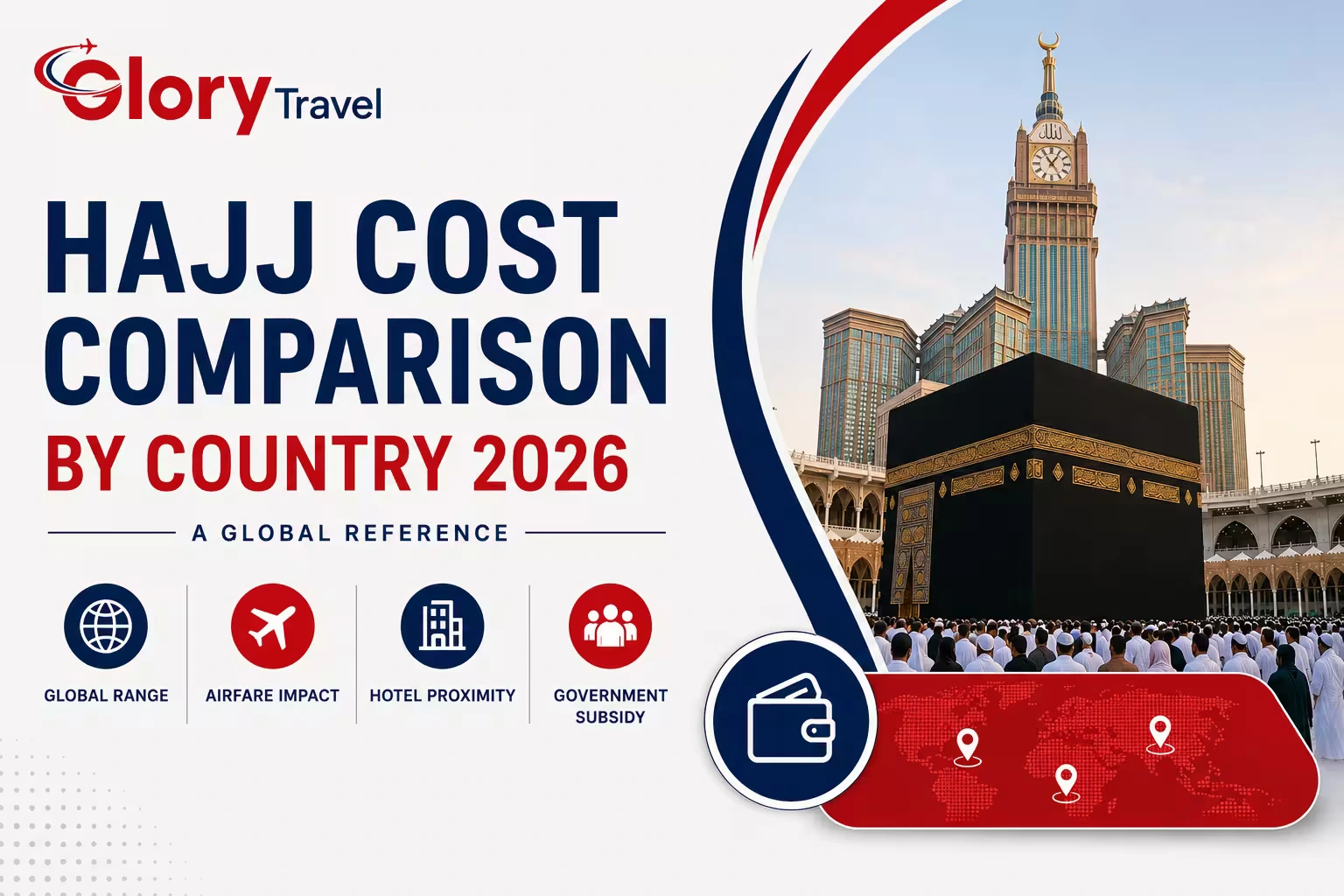
A pilgrim in Jakarta might pay around USD 3,400 while someone in New York pays USD 15,000 for the same pilgrimage. That gap is not random. This is an informational, comparative reference to how Hajj costs vary around the world and why. It does not reflect packages from any single country; for a fuller breakdown, see our country-wise cost guide linked below.
Hajj 2026 package prices ran from roughly USD 3,400 in government-subsidised markets to over USD 15,000 for premium packages from Western countries. The figures below are broad, publicly reported ranges for context only; actual prices depend on operator, tier, flight routing, exchange rates and timing.
|
Country / region |
Rough 2026 range |
Notes |
|
Indonesia |
From around USD 3,400 |
Government subsidises a large share of the cost |
|
Pakistan |
Government ~USD 4,100 to 4,500; private higher |
Government scheme cheaper; private premium tiers cost much more |
|
India |
Government (lottery) plus a 2026 surcharge; private higher |
Hajj Committee packages regulated; private budget options exist |
|
Malaysia |
Subsidised via Tabung Haji |
Very long waiting list for new registrants |
|
Singapore |
Around SGD 9,500 to 12,000+ |
Administered by MUIS; small quota, long queue |
|
UK |
Economy around GBP 5,000 to 8,000; premium GBP 15,000+ |
Private operators only, no government scheme |
|
USA |
Economy around USD 8,000 to 12,000; premium USD 15,000+ |
Private operators only; long-haul flights add cost |
|
UAE / Bahrain |
Lower airfare due to proximity |
Money saved on flights can go toward accommodation |
Four structural factors explain most of the gap between countries.
**Government subsidy and scheme. **Countries with national Hajj bodies (Indonesia, Malaysia, Pakistan, India, Nigeria and others) negotiate bulk rates and sometimes subsidise pilgrims, so their official packages are typically 15 to 30 percent cheaper than private operators.
**Distance and airfare. **Airfare is 30 to 40 percent of the cost. Pilgrims near Saudi Arabia (the Gulf) pay far less to fly than those from the USA, UK or East Asia.
**Hotel proximity to the Haram. **The closer the Makkah hotel, the higher the price; premium packages pay for that proximity.
**Shifting vs non-shifting and duration. **Shifting packages (relocating from a cheaper Mina-area hotel) cost less; longer stays cost more.
In countries with well-run government schemes, the official package is usually the best value, thanks to bulk purchasing power. The trade-offs are less flexibility, more basic accommodation, larger groups, and sometimes very long waiting lists. Private operators offer more comfort, smaller groups and closer hotels at a premium. Which is right depends on your budget, patience and comfort needs.
Countries with national Hajj authorities (Pakistan, India, Indonesia, Malaysia, Egypt, Nigeria, Turkey and others) require registration through the government ministry first, with a quota of roughly 1,000 pilgrims per million Muslims and, often, a lottery when demand exceeds supply. Countries without a dedicated authority (UK, USA, Canada, much of Europe and East Asia) register through Nusuk and book with Nusuk-approved private operators. The official Nusuk channel (hajj.nusuk.sa) is the only authorised route, and any site claiming otherwise should be treated with caution.
These ranges are a global reference to help you understand where costs come from, not a price list you can book from. For actual, current figures and a fuller country-wise breakdown, see the guide below and confirm live prices with your own country's official Hajj channel or a licensed operator.
For more detail on the components that make up the total, see our Hajj cost breakdown.
How much does Hajj cost around the world in 2026?
Roughly USD 3,400 in government-subsidised markets like Indonesia up to USD 15,000 or more for premium packages from the USA and UK. Your cost depends on your country, flight distance, hotel proximity to the Haram and package tier.
Why does Hajj cost so much more from some countries?
Four factors: whether a government scheme subsidises and bulk-buys, flight distance and airfare (30 to 40 percent of cost), how close the Makkah hotel is to the Haram, and the package tier and duration.
Are government Hajj packages cheaper than private ones?
Typically yes, by around 15 to 30 percent, thanks to bulk purchasing. The trade-offs are less flexibility, more basic accommodation, larger groups and sometimes very long waiting lists.
How are Hajj places allocated by country?
Saudi Arabia sets a quota of roughly 1,000 pilgrims per million Muslims. Countries with national Hajj authorities allocate places (often by lottery) through their ministry; others register through Nusuk and book with approved operators.
Is Nusuk the only way to book Hajj?
For countries without a national Hajj authority, registration goes through Nusuk and Nusuk-approved operators, and hajj.nusuk.sa is the only authorised channel. Countries with a government scheme register through their own ministry first.

Glory Travel and Tours offers unforgettable journeys with expertly crafted Hajj, Umrah, and leisure packages. Committed to excellence, we ensure comfort, convenience, and care every step of the way.
Copyright© 2025 GloryTravel. All Rights Reserved.
SHARE THIS BLOG