
“When should I book?” and “when should I travel?” are two different questions. This guide answers the first: how far ahead to reserve, based on when you plan to go. Booking lead time is really about beating demand for flights and hotels near the Haram, and it changes a lot by season.
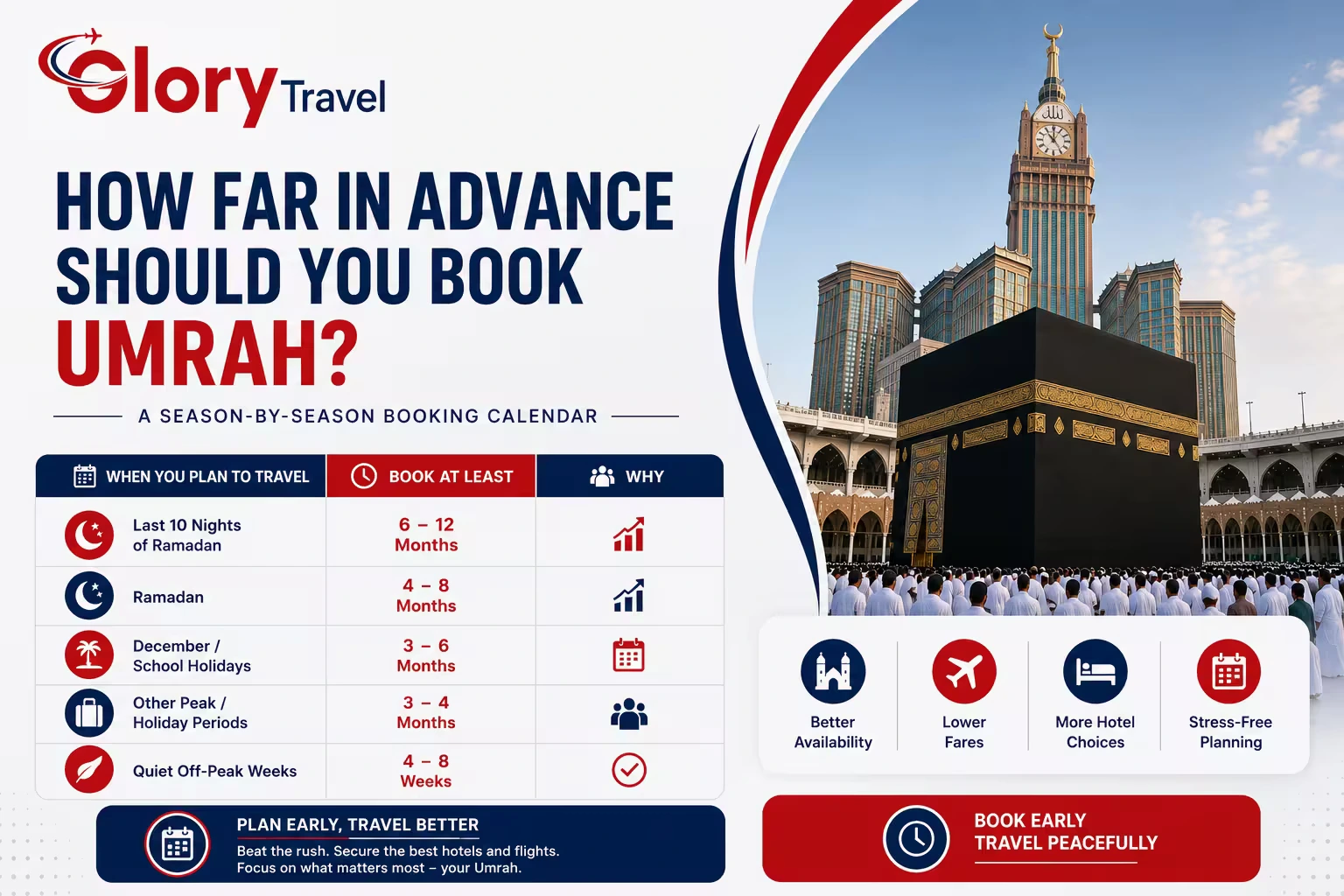
The busier and more sought-after your travel dates, the earlier you need to book. Ramadan and the last ten nights are the extreme; quiet off-peak weeks give you far more flexibility. Use the calendar below as a rule of thumb.
|
If you plan to travel... |
Book at least... |
Why |
|
Last 10 nights of Ramadan |
6 to 12 months ahead |
The most in-demand window of the year; close-in hotels sell out first |
|
Anytime in Ramadan |
4 to 8 months ahead |
Peak demand and peak prices across the whole month |
|
December / school holidays |
3 to 6 months ahead |
Popular family season; cooler weather adds demand |
|
Other peak or holiday periods |
3 to 4 months ahead |
Elevated demand pushes up flights and rooms |
|
Quiet off-peak weeks |
4 to 8 weeks ahead |
Lower demand means more availability and flexibility |
**Hotels near the Haram sell out first. **The closer a hotel is, the earlier it fills, especially in Ramadan and December.
**Flight fares climb as seats sell. **Booking early usually means a lower fare and better times.
**More room-occupancy choice. **Early booking gives you a better chance of the room type and sharing arrangement you want.
**Time to prepare. **An earlier booking leaves room for visa steps, vaccinations and saving.
Since the Umrah visa now must be tied to confirmed, Nusuk-verified accommodation and transport, your hotel and transfer bookings are effectively part of the visa step, not an afterthought. That makes booking early doubly important: your visa cannot be issued until those bookings are confirmed, so leaving it late compresses everything at once.
Outside peak seasons, a last-minute Umrah is possible and can occasionally be cheaper if operators discount unsold inventory. But you trade away choice: the closest hotels and best flights may be gone, and you have less time for visa and vaccination steps. Last-minute is a gamble that rarely pays off during Ramadan or December.
For Ramadan, think in months and book as early as you reasonably can. For popular holiday periods, book a season ahead. For quiet weeks, a few weeks is often enough. When in doubt, book earlier; you rarely regret it, and close-in hotels reward those who move first.
Deciding which season suits you in the first place is a different question, covered in our guide to the best time to perform Umrah.
How far in advance should I book Umrah?
It depends on your travel season. For the last ten nights of Ramadan, 6 to 12 months ahead; for Ramadan generally, 4 to 8 months; for December and school holidays, 3 to 6 months; for quiet off-peak weeks, 4 to 8 weeks is often enough.
When do Umrah hotels near the Haram sell out?
The closest hotels fill first, especially for Ramadan and December. Booking within 500 metres of the Haram for those periods often needs to happen many months ahead.
Is it cheaper to book Umrah early or last-minute?
Early booking usually secures lower flight fares and better hotel choice. Last-minute can occasionally be cheaper off-peak if operators discount unsold inventory, but you lose choice and time, and it rarely helps during Ramadan or December.
Does the 2026 visa rule affect when I should book?
Yes. The Umrah visa now must be tied to confirmed accommodation and transport bookings, so those are part of the visa step. Booking early ensures your visa can be issued without a last-minute scramble.
Can I book Umrah at the last minute?
Outside peak seasons, yes, and it can occasionally be cheaper. But the closest hotels and best flights may be gone, and you have less time for visa and vaccination steps. Avoid last-minute for Ramadan and December.


Glory Travel and Tours offers unforgettable journeys with expertly crafted Hajj, Umrah, and leisure packages. Committed to excellence, we ensure comfort, convenience, and care every step of the way.
Copyright© 2025 GloryTravel. All Rights Reserved.

SHARE THIS BLOG