
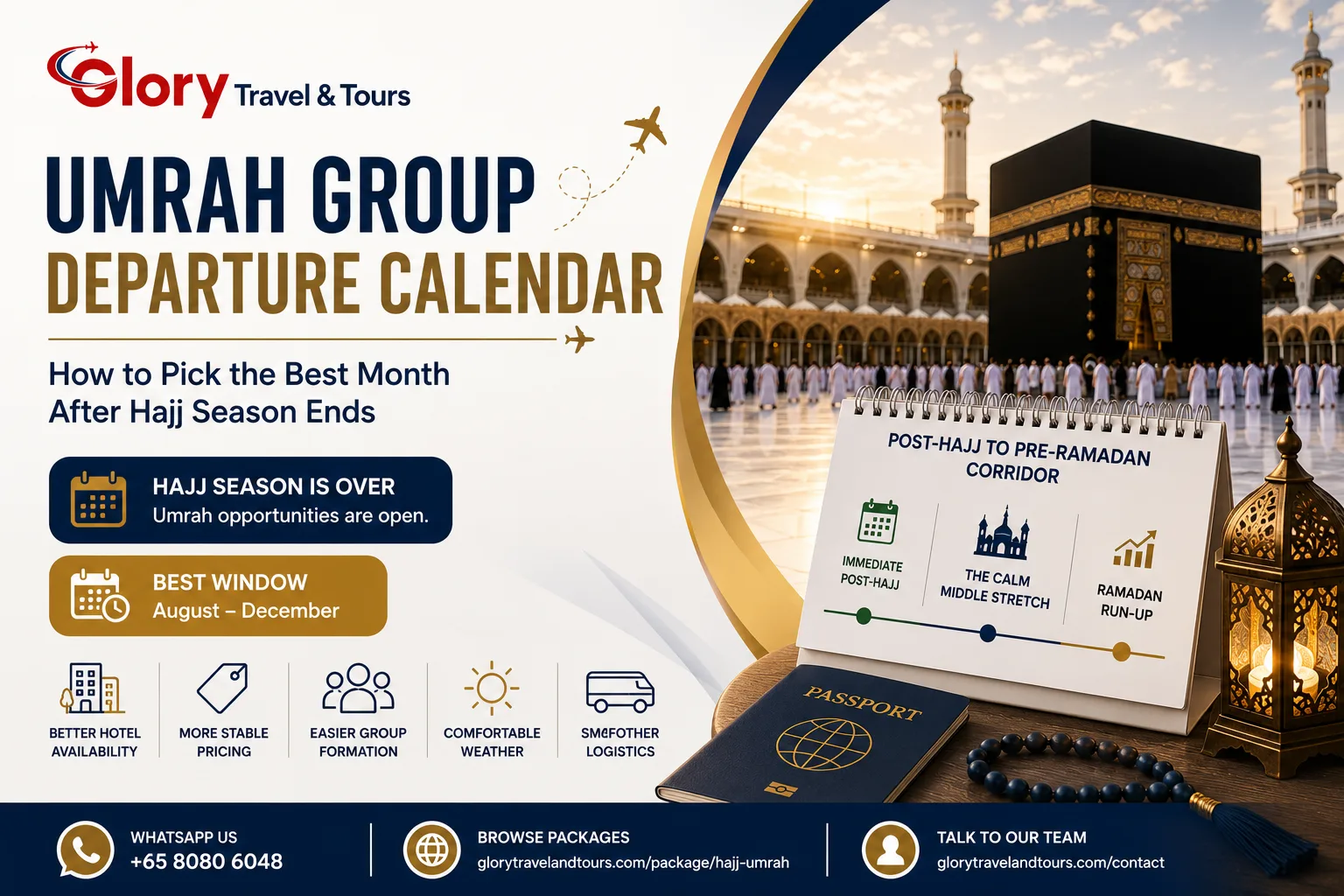
Quick Answer: Once Hajj season ends, roughly from July onward, Makkah's hotel and flight capacity that was locked up for Hajj pilgrims opens back up for Umrah group departures. The window between the end of Hajj and the start of the next Ramadan rush, broadly August through December, offers the calmest booking conditions and most flexible group departure scheduling of the entire year.
Choosing between a group tour and a private, customized Umrah is one decision. Choosing which month to actually depart is a separate one, and it is the one most pilgrims spend the least time thinking about. With Hajj season now behind us, this is the window where group Umrah departures genuinely open up again, and picking the right month inside that window can meaningfully change your hotel options, your price, and how easy it is to fill or join a group.
During Hajj season, Makkah's hotel inventory, ground transport, and Mutawwif (guide) availability are almost entirely absorbed by Hajj pilgrims. Group Umrah operators scale back departures accordingly, since competing for the same hotel rooms and transport slots during Hajj season is neither practical nor cost-effective. Once Hajj concludes, that capacity releases back into the market fairly quickly, and group Umrah departures resume at a pace and price point noticeably better than what was available in the weeks immediately before Hajj.
Between the end of one Hajj season and the start of the next Ramadan rush lies a roughly seven-month corridor, and it breaks down into three distinct booking phases:
Phase 1: Immediate post-Hajj (the first month or two after Hajj ends) Hotel and transport capacity is releasing back to the Umrah market, but pricing has not yet fully settled. Group departures in this window can be excellent value, though itineraries may have slightly less flexibility as operators finalise their revised group schedules.
Phase 2: The calm middle stretch This is the sweet spot for group Umrah departures. Hotel rates are at their most competitive of the non-Ramadan calendar, group sizes are easier to fill since demand is steady rather than spiking, and Mutawwif and ground transport availability is at its most flexible. Operators typically run their widest range of group departure dates during this stretch.
Phase 3: Ramadan run-up (the final one to two months before Ramadan) Demand begins climbing as pilgrims who want an early-Ramadan or Ramadan-adjacent Umrah start booking. Group departure dates fill faster here, and prices begin trending toward Ramadan-level demand even though Ramadan itself has not started.
If your goal is simply to perform Umrah with the easiest booking process, the most competitive group pricing, and the widest choice of departure dates, aim for the calm middle stretch of the post-Hajj corridor rather than the very start (still settling) or the very end (already climbing toward Ramadan demand). If your goal is specifically to be in Makkah for a particular occasion, such as the Islamic New Year, that is a different planning question entirely; see our Umrah New Year Package guide for that specific window.
This calendar answers "which month is easiest for a group departure," which is a different question from "should I join a group or book privately" (covered in our Group Tours vs Customized Tours guide) and different again from "how far ahead should I book" (covered in our Umrah Booking Calendar). All three questions matter, but they answer different parts of the planning process:
|
Question |
Where to find the answer |
|
Which month should I aim for? |
This guide |
|
Group or private/customized? |
Group Tours vs Customized Tours |
|
How far ahead do I need to book? |
Umrah Booking Calendar |
Better hotel availability near the Haram, since Hajj-season block bookings have released
More stable group pricing, without the surcharges that build closer to Ramadan
Easier group formation, since operators are running a fuller schedule of departure dates rather than a compressed one
Comfortable weather for much of the window, particularly compared to the peak heat of the Hajj months themselves
Less competition for Mutawwif and ground transport, translating into smoother day-to-day logistics during the pilgrimage itself
Ask two questions. First, is there a specific date, occasion, or school holiday period you are trying to match? If yes, that constraint should drive your month regardless of general demand patterns. If no, the calm middle stretch of the post-Hajj corridor is very likely your best all-round option: settled pricing, full group schedules, and no Ramadan premium.
Group departures typically resume within a month or two of Hajj concluding, once Makkah's hotel and transport capacity releases back from Hajj-season bookings.
The calm middle stretch of the post-Hajj corridor, well clear of both the immediate post-Hajj settling period and the pre-Ramadan demand climb, generally offers the most competitive pricing and widest choice of departure dates.
A few months later, once pricing has settled from the immediate post-Hajj transition, is often the more stable and competitively priced option, though the very first weeks after Hajj can also offer good value if flexibility is not a priority.
Yes. Demand and pricing both begin trending upward in the one to two months immediately before Ramadan, even for departures that land before Ramadan actually starts, as operators' schedules fill with Ramadan-adjacent bookings.
This guide focuses on group departure logistics and pricing. For a weather- and crowd-focused breakdown by month, see our Best Time to Perform Umrah guide instead.
Glory Travel & Tours (TA 03786) runs a full calendar of group Umrah departures through the post-Hajj season, with clear pricing and confirmed dates.
WhatsApp us for our current group departure schedule: +65 8080 6048
Browse our Umrah packages: glorytravelandtours.com/package/hajj-umrah
Talk to our team about joining a group departure: Contact Glory Travel & Tours


Glory Travel and Tours offers unforgettable journeys with expertly crafted Hajj, Umrah, and leisure packages. Committed to excellence, we ensure comfort, convenience, and care every step of the way.
Copyright© 2025 GloryTravel. All Rights Reserved.
SHARE THIS BLOG