
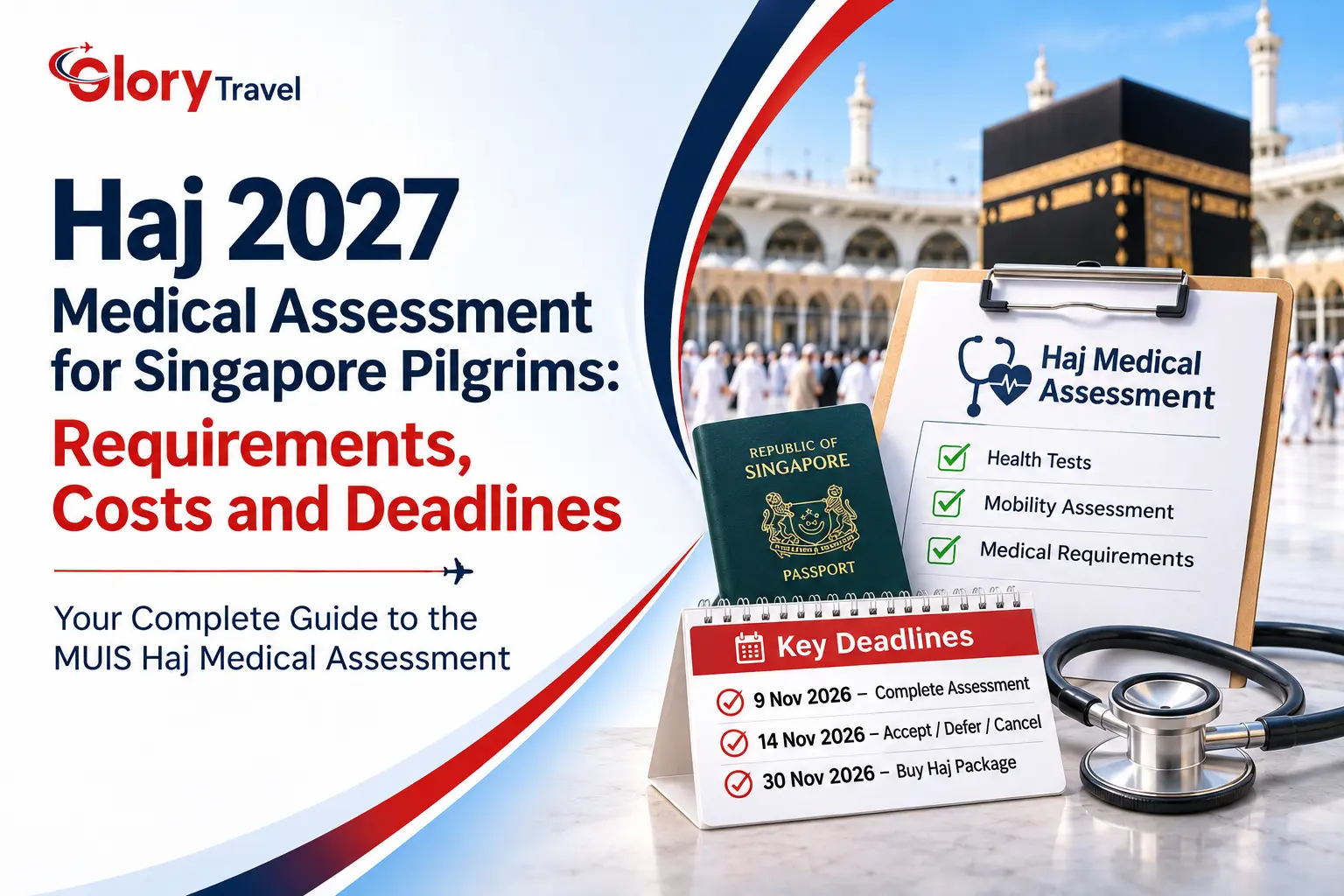
Quick Answer: Every Singapore applicant who receives a Letter of Intent and wants to perform Hajj in 2027 (1448H) must complete a mandatory, in-person Haj Medical Assessment before accepting it. For the current batch, MUIS requires the assessment to be completed by 9 November 2026, the accept, defer or cancel decision on MyHajSG by 14 November 2026, and package purchase by 30 November 2026 for those who receive a Letter of Offer. The assessment costs SGD 125.35 at SATA CommHealth clinics or SGD 261.60 to SGD 283.40 at HMI Medical Centres, and it tests blood work, heart and chest health, cognition and mobility. Well-managed diabetes, high blood pressure and high cholesterol do not automatically disqualify you.
Hajj is a physical journey: long walks, high temperatures and dense crowds. That is why the Saudi Ministry of Hajj and Umrah (MOHU) now sets medical fitness rules for pilgrims, and why MUIS has made a Haj Medical Assessment a mandatory step for Singapore applicants. If you have just received a Letter of Intent (LOI), the calendar is tight, so this guide puts the deadlines first and the detail after.
The dates below come from the MUIS Haj 2027 (1448H) FAQ, last updated on 27 October 2026. They apply to the second batch of LOIs, issued to applicants who registered between 8 March 2014 and 2 May 2014. If you are in a different batch, follow the dates on your own MyHajSG notification.
|
Date |
What has to happen |
|
9 November 2026 |
Complete the Haj Medical Assessment in person |
|
14 November 2026 |
Log in to MyHajSG and choose "I Accept", "I Wish to Defer" or "I Wish to Cancel". Category B decisions from the Haj Medical Panel are also due by this date |
|
From 16 November 2026 |
Successful applicants receive a Letter of Offer on MyHajSG |
|
30 November 2026 |
Last day to buy a Haj package from a MUIS-appointed travel agent |
Anyone who does not wish to proceed can defer or cancel on MyHajSG without taking the assessment. If you want to go but miss the 9 November deadline, MUIS states that you will not be able to proceed with your Haj application for 2027.
The assessment is done in person, not by video, and MUIS says to set aside up to two hours. The tests listed by MUIS are:
|
Section |
What is checked |
|
Blood tests |
Blood glucose (HbA1c), haemoglobin, eGFR for kidney function, liver profile (albumin, bilirubin and INR), and a pregnancy test where applicable |
|
Physical examination |
Blood pressure, chest X-ray, ECG and BMI |
|
Cognition |
A mini-cognitive assessment |
|
Mobility |
Fall history, the Timed Up and Go test (stand from an armchair, walk 3 metres, turn, return and sit), a gait observation, and a 6-Minute Walk Test |
The mobility tests are the part many applicants do not expect. The 6-Minute Walk Test asks you to walk as fast as you can for six minutes, and you may slow down or rest if needed. Treat it as a rehearsal for the walking Hajj involves.
After the assessment, the medical provider emails you a report in one of three categories.
Category A: you are assessed as medically fit. Placement still depends on the available quota and your place in the queue.
Category B: your case needs further review by the Haj Medical Panel, with a final decision by 14 November 2026.
Category C: you are assessed as medically unfit and advised to defer.
Passing the assessment does not guarantee selection. MUIS is clear that final selection depends on both the medical outcome and your position in the registration queue.
MOHU has listed chronic conditions that automatically disqualify an applicant. MUIS summarises them as including failure of a major organ (heart, liver, lungs or kidneys), severe neurological or psychiatric disorders affecting cognition or causing significant motor disability, very frail elderly applicants with dementia, high-risk pregnancy or pregnancy in the final trimester, active cancer treatment with chemotherapy or intensive immunosuppression, active communicable diseases such as pulmonary tuberculosis, and mobility difficulties that prevent you from performing Hajj independently. The list is described as non-exhaustive.
Common conditions are treated differently. MUIS states that diabetes, high blood pressure and high cholesterol do not automatically make you unfit if they are well controlled. You must declare them truthfully so that medical help can be arranged on the pilgrimage, and you should keep your medication, monitoring and doctor follow-ups in order before the journey.
On mobility aids, MUIS says walking sticks may be permitted for minimal support. Applicants who are fully dependent on a wheelchair, scooter or constant human assistance do not meet the MOHU requirement, because the rituals involve long distances, staircases and crowds. This is a Hajj rule. Umrah is a different journey with different rules, so do not assume the same cut-off applies to a family Umrah.
You pay for the assessment yourself, whichever provider you choose. MUIS lists these prices including GST:
|
Provider |
Price |
|
SATA CommHealth (Ang Mo Kio, Bedok, Jurong, Woodlands) |
SGD 125.35 |
|
HMI Medical Centre (Amara and Farrer Park) |
SGD 261.60 to SGD 283.40 |
MUIS strongly recommends its appointed providers because they are set up to complete every test in a single visit. If you prefer your own family doctor, you must submit a request at go.gov.sg/hmarequest after receiving your LOI so that MUIS can send the medical checklist to that doctor. Check first that the clinic can run the full set of tests and ask about fees, because MUIS does not hold fee information for other clinics. If you are overseas and cannot return by 9 November, the same request form lets a certified doctor in your current country conduct the assessment.
Bring your NRIC and your Letter of Intent.
Wear comfortable sports shoes. MUIS states that slippers and sandals are not permitted for the mobility tests.
Take your usual medication, drink water, and eat a light meal. Fasting is not required.
Tell the doctor about existing conditions, current medicines, any falls, and any hospital stay in the past 12 months, including the reason and follow-up care.
Expect your report by email within three to five working days. The provider also submits results to MUIS directly.
Log in to MyHajSG by 14 November 2026. Category A applicants select "I Accept". Category C applicants select "I Wish to Defer" or "I Wish to Cancel". If you are accepted and receive a Letter of Offer from 16 November, you must buy your package by 30 November, so it helps to start comparing packages and payment schedules before the letter arrives.
You will also need to meet the vaccination rules set by the Saudi Ministry of Health and Singapore's Communicable Diseases Agency. MUIS lists meningococcal, pneumococcal and seasonal influenza vaccines as examples and says a detailed advisory will follow closer to departure. If your health changes after you have been certified fit, tell MUIS immediately, because a reassessment may be needed.
Because the package is a large payment, read the refund and cancellation terms before you sign. Our guide to Hajj refund and cancellation policies explains how the registration fee, the package contract and Saudi-side bookings each work.
Is the Haj Medical Assessment compulsory for Singapore applicants in 2027?
Yes. MUIS states that every applicant who wishes to perform Haj in 2027 (1448H) must complete the assessment. It must be done in person, and MUIS strongly encourages using a MUIS-appointed provider.
What is the deadline for the Haj Medical Assessment?
For the batch of applicants who registered between 8 March 2014 and 2 May 2014, MUIS set the deadline at 9 November 2026, with the accept, defer or cancel decision due on MyHajSG by 14 November 2026. Other batches should follow the dates in their own MyHajSG notification.
How much does the Haj Medical Assessment cost?
MUIS lists SGD 125.35 at SATA CommHealth centres and SGD 261.60 to SGD 283.40 at HMI Medical Centres, including GST. The applicant pays regardless of provider.
Can I perform Hajj if I have diabetes or high blood pressure?
Possibly. MUIS says diabetes, high blood pressure and high cholesterol do not automatically disqualify an applicant if they are well managed. You must declare them truthfully and keep them under control through medication and regular doctor follow-up.
Can I use a wheelchair for Hajj if I am selected through MUIS?
MUIS states that applicants who are fully dependent on a wheelchair, scooter or constant human assistance do not meet the MOHU medical requirement. Walking sticks for minimal support may be permitted.
What happens if I miss the 9 November deadline?
MUIS states that you will not be able to proceed with your Haj application for Haj 2027 (1448H). You can still defer or cancel on MyHajSG by 14 November 2026 without taking the assessment.
Hajj Refund and Cancellation Policies: What Pilgrims Need to Know Before Booking for how the registration fee, package contract and Saudi-side bookings are treated if plans change
Hajj Cost from Singapore & Malaysia 2027: Complete Budget & Package Price Guide for the full budget behind a MUIS package
Hajj Packages 2026 vs 2027: Price Trends and When to Book for how prices are moving between seasons
Best Hajj Packages from Singapore 2026: Complete Guide for the MUIS approval process and package tiers
Top 10 Tips for Planning Your First Hajj Journey for physical and spiritual preparation before departure
Glory Travel & Tours (TA 03786) can walk you through what to compare in a Hajj package and what to ask before you sign, so the 30 November purchase deadline does not catch you unprepared.
WhatsApp us your Hajj package questions: +65 8080 6048
Browse our Hajj & Umrah packages: glorytravelandtours.com/package/hajj-umrah
Speak to our team before you commit to a package: Contact Glory Travel & Tours


Glory Travel and Tours offers unforgettable journeys with expertly crafted Hajj, Umrah, and leisure packages. Committed to excellence, we ensure comfort, convenience, and care every step of the way.
Copyright© 2025 GloryTravel. All Rights Reserved.


SHARE THIS BLOG